In short
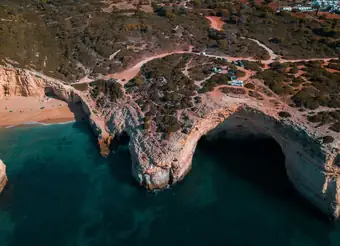
The Algarve has two kinds of beach, and knowing the difference is half the battle. The western and central coast is all dramatic cliffs, arches and sheltered coves — Praia da Marinha, Benagil, Dona Ana and Falésia — with cooler Atlantic water. The eastern coast trades cliffs for miles of soft sand on the barrier islands of the Ria Formosa, where the sea is warmest and calmest.
- Two coasts
- Cliffs & coves vs island sand
- Most iconic
- Praia da Marinha & Benagil
- Warmest sea
- East — the Ria Formosa islands
- Best for surf
- West — Costa Vicentina
How Algarve beaches work: cliffs or islands
Before you pick a beach, pick a type. The Algarve's coast changes completely from west to east, and the two halves suit very different beach days. Get the type right and the specific beach almost chooses itself.
The cliff-and-cove coast
From Lagos through to Albufeira, the shore is a wall of ochre limestone broken by small, sheltered coves reached down steps. These are the postcard beaches — sculpted, sheltered and photogenic — but they are compact, and the water is cooler open Atlantic.
The island-and-sandbar coast
East of Faro the cliffs vanish and the Ria Formosa takes over: barrier islands fronted by kilometres of soft, pale sand, reached by ferry or footbridge. There is far more room, the sea is warmer and calmer, and the crowds thin out. The master list below spans both.
| Beach | Area | Type | Best for | Access |
|---|---|---|---|---|
| Praia da Marinha | Carvoeiro | Cliffs & arches | Scenery, snorkelling | Steep steps |
| Benagil | Lagoa | Sea-cave beach | Boat & kayak trip | By water only |
| Praia da Rocha | Portimão | Big urban beach | Families, amenities | Flat, walkable |
| Praia de Dona Ana | Lagos | Cliff cove | Couples, photos | Steps |
| Praia do Camilo | Lagos | Twin cove | Snorkelling | ~200 wooden steps |
| Meia Praia | Lagos | Long sandy | Families, space | Flat, easy |
| Praia da Falésia | Albufeira–Vilamoura | Cliff-backed sand | Long walks, families | Steps & ramps |
| Praia da Galé | Albufeira | Wide sandy | Families | Flat, easy |
| Ilha de Tavira & Barril | Tavira | Island sand | Warm water, space | Ferry / mini-train |
| Praia de Monte Gordo | V.R.S.A. | Long warm beach | Families, warm sea | Flat, easy |
| Praia do Amado | Costa Vicentina | Surf beach | Surfers | Exposed, cliffs |
Everything that follows sorts these beaches by what you actually want — scenery, family sand, quiet, caves or surf. As a rule of thumb, come to the west and centre for the photographs and the snorkelling, and to the east for the swimming and the room to breathe.
The cliff and cove beaches
The central and western coast holds the beaches the Algarve is famous for. They are small and often involve steps, so go early in summer to be sure of a spot.
Praia da Marinha
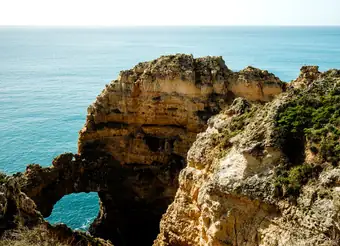
The signature Algarve beach. Its twin rock arches and clear, snorkel-friendly water are the image on every brochure, and the clifftop Seven Hanging Valleys Trail starts here. The reward comes after a steep flight of steps, and it is busy by late morning — arrive early.
Dona Ana and Camilo
Just south of Lagos, Praia de Dona Ana is a golden cliff cove that ranks among the prettiest in Europe, while neighbouring Praia do Camilo hides two small coves at the foot of a wooden stairway of roughly two hundred steps. Both are superb for snorkelling and both fill fast.
Praia da Rocha and Praia da Falésia
For space as well as scenery, Praia da Rocha at Portimão is a broad, flat urban beach with a full promenade, while Praia da Falésia runs for kilometres beneath red-and-white cliffs between Albufeira and Vilamoura — the region's finest long beach walk.
Alvor and the western coves
West of Portimão, Praia dos Três Irmãos hides tunnels and rock stacks worth swimming through, while the long estuary sands of Alvor give families a gentler, flatter alternative to the staircased coves. Between them sits little Praia do Vau, quieter than its famous neighbours and just as golden.
The island and sandbar beaches
The eastern Algarve is where you go for room, warm water and calm. Its best beaches sit on the barrier islands of the Ria Formosa, a short hop from the mainland. What you trade in cliff-cove drama you get back in space: even in August you can walk five minutes along an island and have the dunes to yourself.
Ilha de Tavira and Praia do Barril
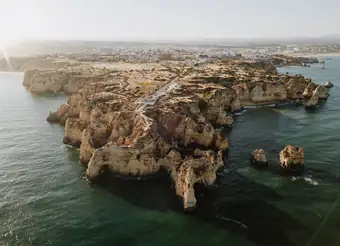
Ilha de Tavira is a long dune-backed island reached by ferry from Tavira, with soft sand and shallow, warm water. At its western end, Praia do Barril — reached from Santa Luzia on foot or by a miniature train — is famous for its anchor cemetery, a field of old tuna-fishing anchors in the dunes.
Cabanas, Monte Gordo and the far east
Further along, the island beach at Cabanas is calm and family-friendly, while Praia de Monte Gordo near the Spanish border has the warmest, gentlest sea in the Algarve and a wide, easy beach that suits small children.
Faro's islands: Culatra, Armona and Deserta
Off Faro and Olhão, boats run to the car-free islands of the Ria Formosa — Culatra, Armona and the Ilha Deserta. These are working fishing-community islands and empty nature reserves rather than resort beaches, and they make one of the calmest, most local beach days in the whole Algarve.
The best beaches for families
What makes a good family beach
For a family day, three things beat scenery: easy access, gentle sea and amenities within reach. That points away from the cliff coves and towards the flat, serviced beaches.
- Praia da Rocha (Portimão) — huge, flat and walkable, with the full run of cafes and toilets.
- Meia Praia (Lagos) — a long, easy strip of sand with space to spread out.
- Praia da Galé (Albufeira) — wide, sandy and calmer than the town beaches.
- Monte Gordo and Cabanas (east) — the warmest, shallowest water in the region.
Wherever you land, look for the lifeguard flags in summer and set up near them; the Atlantic can pull, and supervised stretches are the safe choice with children. With a pram or a toddler in tow, skip the cove staircases at Camilo and Dona Ana altogether — the flat, boardwalked sands of Rocha, Meia Praia and the eastern islands save a great deal of grief.
Quiet and hidden beaches
Even in August the Algarve has empty sand if you know where to look. The rule is simple: walk a little further, or head to the ends of the coast.
Wild west: Sagres and the Costa Vicentina
Around Sagres, Praia do Tonel, Beliche, Mareta and Martinhal stay wild and uncrowded even in peak week, backed by cliffs inside a natural park. It is cooler and windier here, which is exactly why it is quiet.
Small coves and long islands
West of Lagos, the fishing-village beaches of Salema and Burgau keep a local feel, while in the east you can walk a barrier island for ten minutes and have the dunes to yourself. These are the Algarve's antidote to the honeypot coves.
Beaches with sea caves
The Algarve's caves are part of its beach appeal, and the most famous of all — the Algar de Benagil — is a beach in its own right, hidden inside a domed cavern with a natural skylight.
Benagil and the grotto coast
You cannot drive or walk to the Benagil cave beach; it is reached only from the water. The reliable way in is a boat or cave tour from Benagil or Carvoeiro, or a kayak or SUP from the neighbouring beach. The same stretch of coast, around Marinha and Ponta da Piedade, is riddled with smaller arches and grottoes best seen by sea. A cave trip pairs naturally with a beach day at Marinha or Carvoeiro, since the boats leave from the same coves — swim in the morning, then take to the water in the softer afternoon light.
Surf beaches
The Atlantic-facing Costa Vicentina on the west coast is the Algarve's surf country, exposed to swell that the sheltered south coast never sees.
Arrifana, Amado and the west coast
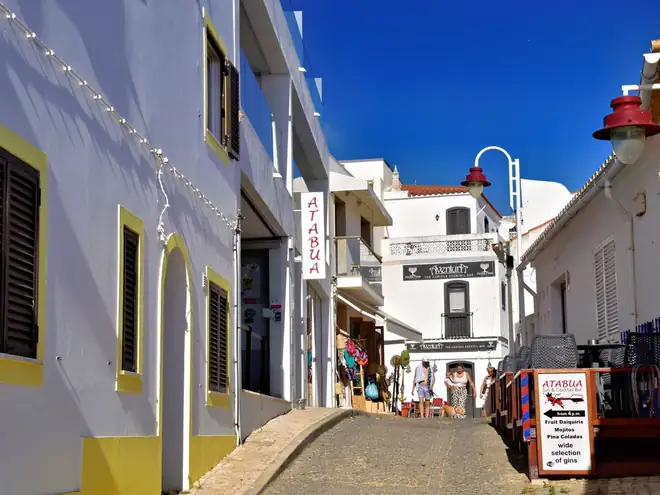
Praia da Arrifana near Aljezur and Praia do Amado near Carrapateira are the headline surf beaches, with schools running beginner lessons through summer and serious waves from autumn to spring. Down at Sagres, Praia do Tonel catches the same swell. See our surfing guide for lessons and seasons.
Which beach for your base?
Where you stay decides which beaches are a five-minute walk and which are a drive. Match your base to the sand:
- Lagos — Dona Ana, Camilo, the Ponta da Piedade coves and the long Meia Praia, all close.
- Carvoeiro & Lagoa — Marinha, Benagil and Vale de Centeanes, the heart of the cliff coast.
- Albufeira & Vilamoura — Falésia, Galé and a string of town coves.
- Portimão — the big, easy Praia da Rocha and the Alvor sands.
- Tavira & the east — the warm island beaches of Tavira, Cabanas and Monte Gordo.
- Sagres — the wild surf beaches of the Costa Vicentina.
If a particular beach is the whole point of your trip, book a stay within walking distance of it — our where-to-stay guide shows the real homes in each town.
Nudist and dog-friendly beaches
Two common questions have simple answers.
- Naturist beaches — the Algarve has a handful of official naturist areas, most notably the far end of Praia do Barril near Tavira and stretches of the wild western coast. Look for the marked zones rather than assuming.
- Dogs — most main beaches ban dogs in the bathing season, roughly June to September, but many quieter and off-season beaches are relaxed. The eastern islands and the western coves are the safest bet outside peak months.
When in doubt, the signage at the access point is the rule that matters.
Beach access and practicalities
On the cliff coast, the difference between a great beach day and a frustrating one usually comes down to steps, parking and timing rather than the sand itself.
Steps, parking and access
Many cove beaches — Camilo, Dona Ana, Marinha — are reached only by long staircases, which rules them out for anyone with limited mobility or a heavy pram. The long sandy beaches (Rocha, Meia Praia, Falésia, the eastern islands) have flat or ramped access. Car parks are small and free at most beaches and fill by mid-morning in summer, so arrive before 10 am or after 4 pm. A few beaches, such as Falésia and the island beaches, have larger or paid car parks that hold up better through the day.
Blue Flags, lifeguards and safety
The Algarve carries dozens of Blue Flag beaches for water quality and facilities — Albufeira alone flies 25. In summer, main beaches are lifeguarded and fly coloured flags: green means safe, yellow caution, red no swimming. Take them seriously; the Atlantic has real currents.
Tides, shade and the wind
Two more things catch visitors out. Tides on the cliff coves can shrink the sand dramatically at high water, so a beach that looks generous at 10 am may be a strip by mid-afternoon. And shade is scarce — only the pine-backed and cliff-backed beaches offer any, so bring your own cover in summer, when the afternoon wind (the nortada) can also pick up on the west coast.
When to go, and how warm the sea is
The best months
Official INE figures make the Algarve Portugal's busiest region — 72.8% occupancy in — peaking in July and August. For the beaches at their best with fewer people, aim for June, September and early October, when the sea is warm and the crowds have eased.
East versus west sea temperature
Sea temperature is the east coast's trump card. The shallow eastern lagoons around Tavira and Monte Gordo warm up fastest and hold the warmest water in the region, comfortable from June to October. The exposed western beaches near Sagres run several degrees cooler year-round — bracing, but the reason the surf and the air stay fresh.
Overrated, underrated: an honest take
The famous beaches earn their fame, but they are not always the right choice on the day.
- Time it, do not skip it: Praia da Marinha and Dona Ana are stunning and worth the steps — just not at midday in August, when the coves are shoulder-to-shoulder. Dawn or late afternoon transforms them.
- Underrated: the eastern island beaches give you Caribbean-style sand and warm water with a fraction of the crowds; most first-timers never make it past the central coves.
- Mind the steps: Camilo is beautiful but its stairway is punishing in the heat — a genuine factor with young children or in a heatwave.
The honest strategy is to pair one iconic cove for the photos with one long, easy beach for the actual lazing — and to let the lifeguard flags, not the guidebook, have the final word. One habit pays off everywhere: check the tide and the wind before you commit to a long day on an exposed cove.