In short
The Algarve is southern Portugal's holiday coast — 150 km of cliffs, coves and warm island sand, with boat tours, golf, seafood and more than three hundred days of sun a year. It suits almost everyone: families, couples, groups, golfers and first-time visitors to Portugal alike. A week is the sweet spot, the shoulder months are the smart time, and Faro airport puts every resort within ninety minutes. This guide is the overview — how long to go, what to prioritise, who it suits and what first-timers get wrong — with links out to the detail.
The Algarve at a glance
If you are starting from scratch, a handful of facts settle most of the planning. The Algarve is compact, warm and easy — a first-timer’s Portugal — and the table below is the thirty-second briefing.
What it is, in a sentence
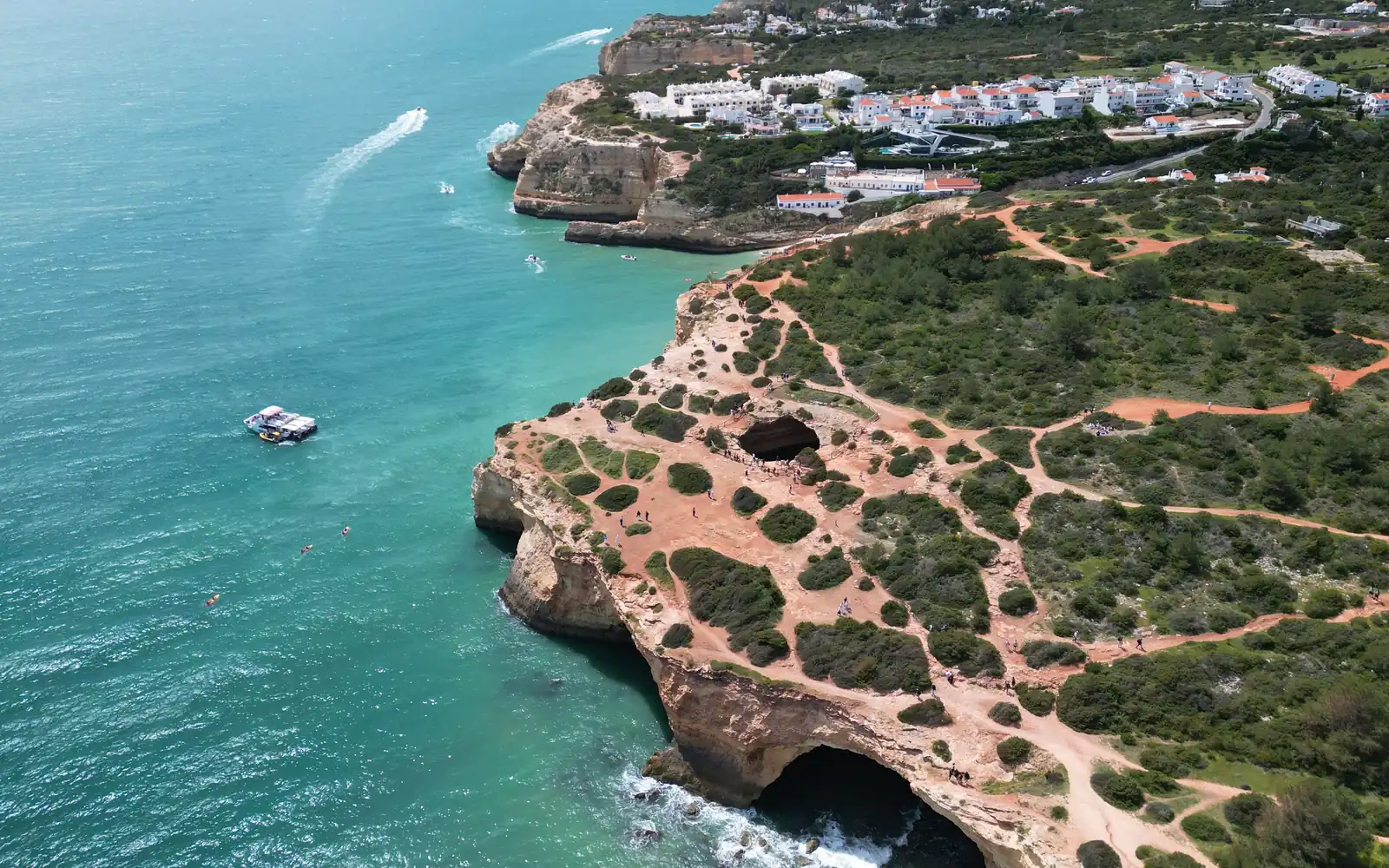
It is the sun-and-sea south of Portugal: a long Atlantic coast that runs from wild surf cliffs in the west, through the famous cave-and-cove beaches of the centre, to warm lagoon islands in the east, backed by low hills of almond, fig and vine. Everything is close, and the light is the draw. Unlike much of the Mediterranean, the water is open Atlantic — cooler and cleaner — and the coast keeps a working, Portuguese character behind the resorts, which is a large part of its charm.
| Question | Answer |
|---|---|
| Where | Southern Portugal, ~150 km of Atlantic coast |
| Airport | Faro (FAO), central-east |
| Getting there | ~2.5–3h flight from the UK; ~2h drive from Seville |
| Language | Portuguese; English widely spoken |
| Currency | Euro (€) |
| Best time | May–Jun and Sep–Oct (shoulder) |
| How long | A week is ideal; 3–4 nights for a short break |
| Need a car? | Not for one resort; helpful for touring |
| Known for | Beaches, boat tours, golf, seafood, sun |
The rest of this guide turns those facts into decisions — and each links to a deeper guide when you want the detail.
Itineraries: how long, and what to do
The single best planning move is to match the trip length to your pace. Here is how the common lengths play out.
The perfect week
Seven days is the Algarve sweet spot. A balanced week runs roughly: two beach days near your base to settle in; a boat trip to Benagil and the caves; a day touring two or three coastal towns; a day inland to Monchique or Silves; a day trip to Seville or Lisbon; and a final slow day for the beach and a long lunch. It covers the coast, the hills and a taste of Spain without ever feeling rushed.
Three or four days
On a short break, stay put and go central — Albufeira, Carvoeiro or Vilamoura — and pick just three highlights: one boat trip, two great beaches and one proper seafood dinner. Keep the driving to nothing and let the coast come to you.
Ten days or without a car
With more time, split your stay between the lively centre and the quiet east for two very different Algarves in one holiday. Car-free travellers can lean on the coastal train, tours with hotel pickup and a central base — see the plan-your-trip guide for the logistics. The one length to avoid is the two-night dash: by the time you have arrived and found your feet, it is time to leave, and you will spend the whole trip feeling you only saw the airport road.
A day-by-day week in the Algarve
To make the classic week concrete, here is one well-tested version from a central base such as Albufeira or Carvoeiro. Swap the days freely around the weather and your energy.
Days 1 to 3: settle in and hit the water
Day 1 — arrive, collect any hire car, and spend the afternoon on the nearest beach, with dinner a street back from the seafront. Day 2 — a morning boat or kayak trip to the Benagil cave and the cliff coast, then the afternoon at Praia da Marinha. Day 3 — a lazy beach day, finished with a sunset drink at a marina or a clifftop bar.
Days 4 to 5: explore the coast and the hills
Day 4 — drive west to Lagos for Ponta da Piedade and the old town, or east to Tavira and an island beach, depending on your base. Day 5 — head inland to Monchique and Fóia or the castle town of Silves, with a jeep safari or a wine tasting to break up the day.
Days 6 to 7: a day trip and a slow finish
Day 6 — a day trip to Seville or Lisbon, or a full day on the Ria Formosa islands. Day 7 — a final slow beach morning and a long seafood lunch before the flight home. It is a week that mixes sea, cliffs, hills and a taste of Spain without a single rushed day, and it flexes easily up to ten days or down to a long weekend.
Who it is for: matching the Algarve to you
Few destinations flex across so many kinds of trip. The trick is choosing the base and the pace that suit your group.
Families and couples
Families do best on the central and eastern coasts, where the beaches are long and the sea is gentle — Albufeira and Alvor for amenities, Tavira and Cabanas for calm. Couples gravitate to the cliff-cove scenery of Carvoeiro and Lagos or the postcard quiet of Tavira and Ferragudo. The east suits anyone chasing calm and good food; the centre suits those who want the beaches, the caves and a livelier evening close at hand.
Groups, golfers and solo travellers
Groups and stag or hen parties head for Albufeira’s Strip and Vilamoura’s marina; golfers for Vilamoura and the Golden Triangle; and solo travellers and digital nomads for the walkable old towns of Lagos, Faro and Tavira, where it is easy to meet people and the wifi is good. A villa suits a group; a central apartment suits a couple or a solo stay.
Teenagers, multi-generational and budget trips
Teenagers are well served by the water parks, surf lessons, kayaking and the boat trips; multi-generational groups do best in a villa with a pool and a central base that puts something for every age within a short drive; and budget travellers lean on the free beaches and cliff walks, the market food halls, and the shoulder season, when the same villa can cost a fraction of the summer rate. The Algarve stretches from backpacker-cheap to genuinely luxurious without ever feeling like two different places.
First-timer’s guide: the common mistakes
What first-timers get wrong
The classic errors are avoidable. People over-drive, choosing a pretty western base then losing hours on every airport run and day trip; they visit the honeypot beaches at midday in August and find them packed; and they eat on the resort seafront rather than a street back, paying more for less. Many also under-rate the interior and the east, and never leave the beach at all.
What to prioritise instead
Get three things right and the rest follows: a central base to save time, the shoulder season to save money and crowds, and a mix of coast, hills and one day trip so you see more than sand. Book flights, villa and one or two headline tours early; leave the beaches and meals to the day. And resist the urge to cram — the Algarve is a place to enjoy slowly, and a half-empty itinerary with room to linger over lunch nearly always beats a packed one.
Off-season: the Algarve beyond summer
The Algarve is a genuine year-round destination, and the quiet months are a different, arguably better, trip.
Spring and autumn
May, June, September and October are the connoisseur’s months: warm sea (warmest of all in September), comfortable sun, thin crowds and prices well below the peak. The boat tours, the beaches and the golf are all at their best, with room to enjoy them.
Winter
Winter is mild and green, the coast at its emptiest. It is prime time for golf, for walking the cliffs and the Costa Vicentina, for the Monchique hills, and for day trips — a bargain, low-key Algarve that most summer visitors never see. Do not expect beach weather — the sea is cold and some resort businesses close — but for a golf, walking or slow-travel trip, winter is the region’s best-kept secret.
Combining the Algarve with the rest of Iberia
The Algarve pairs naturally with its neighbours, and a little geography makes a two-centre trip easy without an extra flight.
With Lisbon
Lisbon sits under three hours north by car, train or coach, so a popular two-week trip is a few days in the capital followed by a week on the coast — city and beach in one holiday. Many visitors fly into Lisbon, work their way south, and fly home from Faro, or the reverse.
With Andalusia
To the east, Seville is around two hours away across the Spanish border, making a combined Algarve-and-Andalusia loop straightforward for drivers. Even a single day trip gives a taste of Spain from an Algarve base, and a longer route can take in the Ria Formosa, the border towns and Andalusia in one arc.
What to pack for the Algarve
The essentials
Pack light and for the sun. The non-negotiables are high-factor sun protection, a hat and water — the summer sun is strong — plus swimwear, a light cover-up and non-slip sandals for the cove staircases and rocky beaches. A dry bag keeps a phone safe on boat trips, and a reusable water bottle saves money and plastic.
Seasonal extras
In spring and autumn bring a light layer for cooler evenings and the odd shower; in winter, a proper jacket and closed shoes for the hills and the cooler Atlantic air. UK visitors need a two-pin European adapter, and anyone hiring a car should carry their licence and, ideally, arrange a toll device with the rental firm before setting off.
The honest Algarve: overrated and underrated
After the brochures, a little honesty. The region is superb, but not every famous name deserves your whole trip.
- Overrated for some: Albufeira’s Strip (brilliant for a party, wrong for calm) and the midday summer scramble at the famous coves.
- Underrated: the eastern fishing towns and island beaches, Algarve wine, the Monchique hills, and the whole shoulder season — all quietly better than their fame.
- Non-negotiable: a boat trip to the cave coast, a plate of fresh seafood, and one day off the beach — miss these and you have missed the Algarve.
Travel a little against the crowd — a shoulder month, a quieter base, an early start — and you get the Algarve at its considerable best. The region has been a package-holiday staple for fifty years, and it is easy to see only that version; the reward for looking a little harder is one of the most varied, good-value coastlines in Europe.
Been before? A second Algarve
If you already know the caves and the central resorts, the region rewards a second, deeper look — there are really several Algarves stacked into one small coast.
Go west, go east, go up
Trade the honeypots for the wild Costa Vicentina in the west, where surf beaches and empty cliffs sit inside a natural park; the eastern islands and fishing towns of the Ria Formosa, all warm water and seafood; and the Monchique hills inland, with their spa, forests and medronho. These are the three Algarves most first-timers never reach.
Slow it down
A return trip is also the moment to slow down: stay a week in one quiet town, add the wine estates around Lagoa, walk a stretch of coast path, and come in the shoulder or winter season when the crowds are gone. Done that way, a place you thought you knew feels like a different, calmer country.
How to use this guide
This page is the overview. When you are ready for the detail, each part of the trip has its own deep guide.
The full library
Dive into things to do for the experiences, destinations to choose a base, beaches to find your stretch of sand, golf and food and wine for those passions, and plan your trip for the transfers, timing and where to stay. Fresh, dated pieces live on the blog. Together they cover the trip end to end — from the first flight search to the last long lunch — so you can plan as lightly or as thoroughly as you like and still arrive knowing exactly what the Algarve has for you.